
Disclosure: This article contains affiliate links to EverBee (ad) and eRank (ad). I earn a commission if you buy a plan through them, at no extra cost to you. It also mentions AutoKeyWorder, which is my own product (ad, own product). I recommend the cheapest way to use EverBee below, which pays me less than the expensive way.
EverBee pricing in one line: Hobby is free, Growth is $299 a year or $39 a month, and Business is $828 a year. The $24.99 on the pricing page is the yearly price split into 12 parts, not the month-to-month price. I found no free trial and no refund terms on the pricing page.
My verdict: stay on the free Hobby plan until you have a niche question only sales estimates can answer. Then pay for one month, not the year. At $299, EverBee Growth costs more than my own small Etsy shop earns in a year.
I checked EverBee’s pricing, annual-offer and comparison pages on 5 October 2026 and copied every price and limit by hand. I don’t use EverBee, so everything about its features and accuracy comes from its own pages. The shop figures further down are mine.
How Much Does EverBee Cost Per Month?
EverBee’s Growth plan costs $24.99 a month when you pay $299 for the year, or $39 a month if you pay monthly. The Hobby plan is free with 10 keyword searches. Business is $69 a month, billed as $828 a year. These figures come from EverBee’s own pricing and annual-offer pages, read on 5 October 2026.
| Plan | Pay yearly | Pay monthly |
|---|---|---|
| Hobby | $0 | $0 |
| Growth | $299 ($24.99 a month) | $39 |
| Business | $828 ($69 a month) | Not shown on the page I read |
What each plan lists on EverBee’s pricing page (read 5 October 2026):
- Hobby: 10 keyword searches (no period stated), views, reviews and favourites only, 5 saved keywords and shops.
- Growth: unlimited keywords, sales, revenue and conversion rate per listing, Tag Analyzer, 100 AI actions a month, 3 stores, and Model Context Protocol (MCP) access, which links AI assistants to your data.
- Business: unlimited AI actions and stores, 3 to 24+ months of trend history, custom filters.
Sources: EverBee pricing and EverBee’s annual offer, both read 5 October 2026.
The free plan is a demo. It shows views, reviews and favourites, while hiding the sales and revenue numbers that most people install EverBee for. If you only want to look around, Hobby is enough. If you want the numbers, you need Growth.
Which Growth Price Is Real: $24.99, $29.99 or $39?
Three different numbers float around for the same plan. Here is where each one comes from.
- $24.99 a month is the pricing page headline. It is $299 divided by 12, and you pay the $299 once.
- $39 a month is the price on EverBee’s annual-offer page if you pay monthly. The same annual-offer page shows $468 a year for monthly billing, so the yearly plan saves $169. EverBee calls that 36%.
- $29.99 a month appeared in Google’s AI summary when I searched “everbee pricing” on 5 October 2026. I couldn’t find it on any EverBee page I read, so I’d ignore it.
Older review posts add more noise. A January 2024 review still ranks on page one and quotes a $7.99 Pro plan, which isn’t on the pricing page now. If a review doesn’t show a date next to its prices, assume they are wrong.
Want the sales estimates without the yearly commitment? EverBee’s annual-offer page says “Cancel anytime · Keep access for the period you paid for”. I couldn’t confirm the terms for monthly billing without paying, so read them on the checkout screen before you enter a card.
EverBee Store Is Now OpoShop: Not This Article
If you came here from a video about “Essentials, Core and Advanced” plans, that is a different product. EverBee’s old store-pricing page now says “EverBee Store is now OpoShop”, and its help centre lists separate plans with transaction fees for building your own web store.
This article covers only the Etsy research extension: Hobby, Growth and Business. Its prices have nothing to do with OpoShop’s.
What You Get for the Money
Growth gives you one thing worth paying for, plus a few extras.
The one thing is the sales and revenue estimate. According to EverBee’s pricing page, Growth adds modelled sales, revenue and conversion rate to each listing, so you can sort a niche by revenue and see which listings carry the money. Hobby doesn’t show it.
The extras are Tag Analyzer, 100 AI actions a month and MCP access. The pricing page doesn’t say what counts as one “AI action”, so I can’t tell you how far 100 goes. MCP access matters only if you already connect AI assistants to your own data. Most Etsy sellers can ignore it.
One conflict I couldn’t settle: the pricing page lists Tag Analyzer under Growth, while EverBee’s comparison page says the free Hobby plan covers it. Check the live page before you count it as a reason to pay.
The AI actions and Tag Analyzer belong to the listing-copy side of the job. Product research is a different step, and I’d keep the two separate.
The tag-writing step, from the photo. AutoKeyWorder (ad, own product) is a Chrome extension that reads your listing photo and fills the Etsy title, all 13 tags and the description in the listing editor, about 5 seconds per image, with no CSV export. AutoKeyWorder does not estimate sales. It installs free with 50 credits and no credit card (Etsy walkthrough).
Install AutoKeyWorder free, 50 credits, no card Try 13 tags from one photo, no signup
Does Growth Pay for Itself? The Break-Even Maths
EverBee Growth pays for itself only if your average order is high enough, because the plan costs a fixed $299 a year, or $468 on monthly billing. At a $5 average order you need 60 orders on the yearly plan, at $15 you need 20, and at $30 you need 10. Those counts are revenue, not profit, so the real number is higher after Etsy takes its fees. In my own shop, with an average order of about EUR 3.30 and roughly 65 orders a year, the yearly plan would cost more than the shop earns, so I stay off it. A seller with a $15 to $30 average order who is choosing a niche from scratch can reasonably pay for one month at $39, run all the research in that month, and stop. Everyone else should do the break-even sum first and only then decide.
The table below is my own calculation from EverBee’s list prices.
| Average order | Growth, $299 yearly | Growth, $468 monthly-billed |
|---|---|---|
| $5 | 60 orders | 94 orders |
| $15 | 20 orders | 32 orders |
| $30 | 10 orders | 16 orders |
Business at $828 needs 166, 56 and 28 orders at the same three prices.
Now my own shop, because it’s a good example of the bad case.
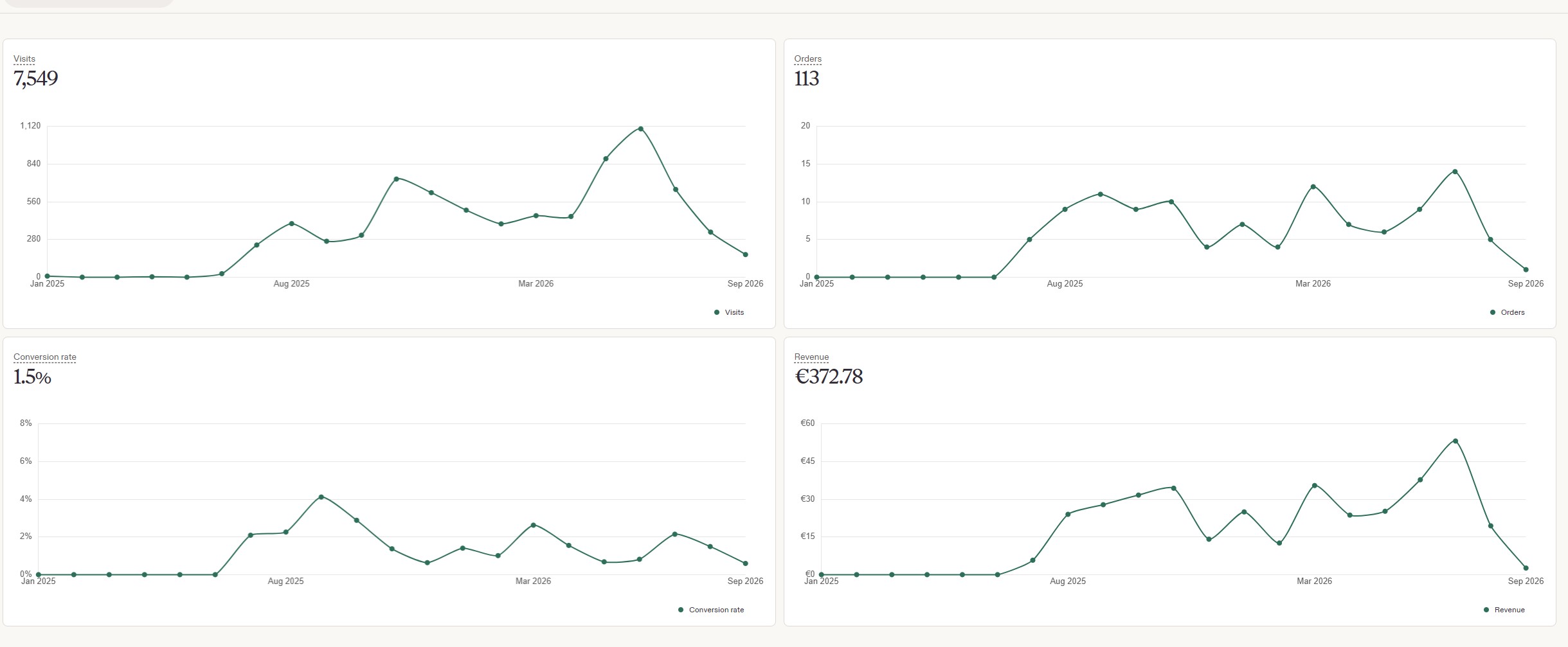
That’s the unedited stats page from my HappyVectors shop, captured on 17 September 2026. It has made EUR 372.78 from 113 orders since January 2025, and the last months went down.
- The average order is about EUR 3.30 (372.78 divided by 113).
- Etsy takes about EUR 0.65 of that. That’s 6.5% transaction plus 4% + EUR 0.30 payment processing at German rates, from my how to sell on Etsy fee table. It leaves about EUR 2.65 before listing fees.
- The shop averages about EUR 213 of revenue a year. That’s EUR 372.78 spread over roughly 21 months.
Growth at $299 would cost more than the whole shop earns in a year. At EUR 3.30 an order the plan needs roughly 80 to 90 orders a year, depending on the dollar-euro rate, and my shop makes about 65 (113 in 21 months). The same plan is a different bet at a higher price: at a $15 average order it needs 20 orders, under two a month, and at $30 it needs 10.
Run that sum with your own average order before you pay. If the answer is “more orders than I get in a year”, stay on Hobby.
Is EverBee Worth the Money?
For a seller with a $15 to $30 average order who is picking a niche from scratch, yes, for one month. For everyone else, I’d skip the paid plans.
What sucks about EverBee. The estimates are modelled, not measured. Etsy doesn’t share sales data with third parties. EverBee’s own comparison page says its algorithm “maintains an average accuracy rate of approximately 80%” and doesn’t explain how the estimate is built. That’s the vendor’s number, EverBee doesn’t say what it measures, and I haven’t tested it. If it means the average miss, estimates could be off by about a fifth, in a direction you can’t see.
The $24.99 headline is a $299 commitment. The pricing page I read lists no free trial and no refund terms. Paying $299 to find out whether you like it is a bad deal when the monthly price is $39. If you want the data, take the monthly plan for the one month you need it and check the cancel terms at checkout first.
For the full side-by-side with the keyword tool I’d pay for first, read my eRank vs EverBee comparison. Short version: eRank tells you what shoppers type. EverBee models what a competitor sells. My best Etsy SEO tools roundup puts eRank’s numbers next to Etsy’s own on 5 phrases, and they never matched.
Which EverBee Plan Should You Buy?
I’d pick like this:
- No shop yet, or fewer than 10 listings: Hobby. Spend the 10 free keyword searches, then read my what to sell on Etsy guide for the manual check.
- Picking a niche before you make anything, average order above $15: Growth for one month at $39. Do all the niche research during that month.
- A busy shop that researches every month and clears the break-even table: Growth yearly at $299.
- Several shops and a team: Business, only if the 3-store limit on Growth actually blocks you.
If you only need keywords, eRank Basic does that job at $5.99 a month. That price is from my 8 September 2026 read, so check it before you buy.
One month of sales estimates, then decide. EverBee Growth on monthly billing is $39 against $299 for the year, and the estimates are the only thing Hobby hides. For keyword research, eRank’s free plan gives you 5 lookups a day.
When to Skip EverBee
- You sell on Redbubble or TeePublic. EverBee reads Etsy only. The Redbubble vs Etsy comparison shows which platform fits a low-price product.
- You want Etsy’s real numbers. Etsy’s own Stats tab and Marketplace Insights are the only figures Etsy has confirmed. The Etsy SEO guide shows how I read my own search terms from Stats.
- You already have a niche and your listings don’t sell. Research won’t fix that, because the problem sits after the click. Start with the Etsy listing optimization checklist, then fix the 13 tags with the Etsy tags guide.
The Verdict
If your average order is EUR 3.30 like mine, Growth won’t pay for itself at any billing length. Write your break-even number down before you click buy.