
Disclosure: This guide has an affiliate link to eRank (ad). If you buy a plan through it I earn a commission, and you pay the same price. AutoKeyWorder, mentioned below, is my own product (ad, own product). Etsy pays me nothing for this guide.
I checked every tag on my current Etsy listings against the searches that brought visitors to those listings. That is 416 tags. Only 11 of them matched a search that brought a visit word for word, and all 11 were plain product names like “school icons” and “wedding icons”.
That result changed how I write tags, and this guide is built on it. HappyVectors, my small Etsy shop, sells digital icon packs as SVG and PNG files. Etsy’s tag rules take two minutes to learn. Choosing the words to put in them is the hard part, so most of this guide is about that. If you have no shop yet, read how to sell on Etsy first. In short, here is how to use tags well: lead with the product name, fit 13 different phrases into 20 characters each, then read your search terms after a few weeks and swap out the tags that never matched.
The short answer: an Etsy tag is a word or short phrase that Etsy matches against shoppers’ searches. You get up to 13 per listing, up to 20 characters each. Use all 13, write them as phrases a buyer would type, start with the plain name of your product, and don’t spend slots on words that only describe the delivery or the machine.
What are Etsy tags, and what is the Etsy tag limit?
Etsy tags are the keywords you attach to a listing so that Etsy search can match it to what shoppers type. Each listing takes up to 13 tags, and each tag can be up to 20 characters long.
A tag can be a single word or a short phrase, so “silver earrings” is one tag. Etsy’s help page says tags work best for words that no attribute covers, such as buyer-minded phrases like “gift for her”. Titles, attributes and descriptions feed the same matching, so tags are one input among several, and anything a category or attribute already says does not need a tag slot. That is why the Etsy tag limit matters less than what you put inside it: 13 slots of 20 characters give you 260 characters to describe the item in the words a buyer would use.
| Rule | What Etsy says |
|---|---|
| Number | Up to 13 tags per listing |
| Length | Up to 20 characters per tag, spaces included |
| Characters | Letters, numbers and spaces. An apostrophe or hyphen only inside a word |
| Form | A word or a short descriptive phrase |
Source: Etsy’s help page How to Use Tags to Get Found in Search, read in an archived copy dated 8 February 2026, because Etsy blocked my fetch of the live page. Check the live page before you rely on a number.
Two more lines from that page matter for everything below. “Tags are helpful when there’s no matching attribute and are great for aspirational or buyer-minded search terms (for example, ‘gift for her’).” And: “To increase your search visibility, use a diverse array of tags.”
Etsy says “up to” 13. I use all 13, because Etsy’s own line is “Each tag is an opportunity to be matched with a shopper’s search”, and an empty slot is a lost chance. To add tags, open Shop Manager, go to Listings, pick the listing, and find Tags under Details. Type the words and select Add.
Only 11 of my 416 Etsy tags matched a search word for word
Etsy’s Shop Manager shows, for each listing, the search terms that brought visits. I took my 2026-09-15 snapshot of those terms and checked each tag against the terms for its own listing. The snapshot had tags for 32 of my 34 listings, so 416 tags in all, 345 of them different. My Etsy SEO guide counted search terms. This time I counted tags.
For every tag I asked two questions. Did a search term that brought a visit equal the tag exactly? And did a term contain every word of the tag, in any order and ignoring a plural s, so “icon” counts as “icons”? About 40 of the terms are non-English, and they can only ever count as misses.
| Type | Tags | All words | Exact |
|---|---|---|---|
| Topic and format | 320 | 27 (8%) | 11 |
| Machine or software | 55 | 1 | 0 |
| Gift | 11 | 0 | 0 |
| Delivery | 30 | 0 | 0 |
| All tags | 416 | 28 (7%) | 11 (3%) |
“All words” means every word of the tag appeared in a search term that brought a visit. “Exact” means the term was the tag. Topic and format tags are phrases like “school icons” and “farm animal svg”. Machine tags are “cricut cut files” and similar. Delivery tags are “digital download” and “instant download”. Source: my Etsy Shop Manager listing stats, all time, read 15 September 2026, computed with a script that is in my notes.
As of that snapshot, 777 visits came with a search term, and 81 of them (10%) came through a term that held every word of one of that listing’s own tags.
Product names were the tags that matched. All 11 exact matches were the name of the thing I sell, sometimes with a format word like svg: “wedding icons”, “teacher stamps”, “school icons”, “education svg”, “farm animal svg”, “swimwear svg”. The three biggest by visits were “school icons” (19 visits from terms holding both words), “teacher stamps” (13) and “wedding icons” (11). That is the pattern I now build on: the buyer’s own name for the item comes first, and every other tag has to earn its slot. Most product-name tags still matched nothing. By my own count, in my shop stats, only 27 of the 320 (8%) had every word in a visiting search term. The other three groups did far worse.
Delivery, gift and machine tags matched almost nothing. My 30 delivery tags matched no visiting search. Neither did the 11 gift tags, and only one of my 55 machine tags did.
That doesn’t prove they are useless. A tag can put you in a result list without anyone clicking, and Shop Manager only shows terms that produced a visit. Etsy also recommends buyer-minded tags like “gift for her”, and 11 gift tags is a small sample. Still, 96 of my 416 tags, almost a quarter, sit in these three groups, and only one of the 96 matched a visiting search.
Two listings show the gap. My Teacher & School Vector Icons listing has 388 visits and 15 sales. Six of its 13 tags matched a visiting term.
My Birth Month Flower bundle has 230 visits and no sale. Only one of its 13 tags matched anything. Its tag said “birth month flower”, while shoppers typed “birth flower svg” and “birthflower svg”. Its other tags, such as “sun catcher template” and “silhouette tattoo”, were uses I hoped for, not words buyers used.
The limits of this test. It is one small shop with cheap digital files, so I can’t tell you it holds for handmade or physical goods.
Both listings above also differ in photos and price, so tags did not cause those sales alone. Etsy also matches on titles, attributes and descriptions, and it translates listings. Tags don’t decide sales on their own. Most of mine matched nothing.
How to choose your 13 Etsy tags
Here is the method I now use, in the order I use it.
- Name the product the way a buyer would. Write the plain name plus the format: “wedding icons”, “teacher stamps”. Put two or three tags like this first. Every exact match in my data looks like this, and none of them are poetry.
- Fill in the attributes before the tags. Attributes are the extra fields Etsy shows when you list an item, such as colour, occasion or holiday. Which fields you get depends on your category. Etsy says tags help “when there’s no matching attribute”, so use the tag slots for what the attributes can’t say.
- Cover different searches, not one search 13 times. Etsy asks for “a diverse array of tags”. My rule of thumb, which I haven’t tested as a formula: 2 or 3 tags for the product name, 2 for the format or style, 3 for who or what it is for, 2 for the occasion or the buyer’s goal, and 3 for close-by phrases a buyer might type instead.
- Write for the searcher’s words, not yours. My Birth Month Flower tag said “birth month flower”. Visitors typed “birth flower svg”. Before you finish, type your main phrase into Etsy’s search bar and read the autocomplete. Those are real searches.
- Fit the 20 characters. The median tag in my shop is 16 characters long, and 96 of the 416 use 18 to 20. Long tags are fine when every word earns its place. If “wedding invitation icons” is 24 characters, “wedding icons” is 13 and it’s the phrase people typed.
- Skip slots that only say “file” or “machine”. “digital download” sat on 16 of my listings and matched nothing. If it is a digital listing, Etsy already knows. Put a product word in that slot.
One open question: some guides, Printify’s among them, say Etsy matches tags by root word, so “cut file” and “cut files” waste a slot. Etsy’s tags page says nothing about plurals. None of my listings hold the same phrase in both singular and plural, so my data can’t settle it. I avoid the pairs, because a different phrase costs me nothing.
What are good Etsy tags? A real set, with the misses
This is the full tag set of my school icon listing, the one with 15 sales. A “yes” means the tag matched a visiting search.
| Tag | Matched |
|---|---|
| teacher svg | yes |
| school icons | yes, the top term |
| classroom clipart | yes |
| education svg | yes |
| back to school | yes |
| line icon svg | yes |
| cricut cut files | no |
| silhouette svg | no |
| outline clipart | no |
| planner stickers | no |
| bulletin board | no |
| teacher labels | no |
| classroom decor | no |
What I’d change: the two machine tags, and probably “outline clipart”, because visitors used the word “outline” inside longer phrases like “school supply outline svg”. “education icons” brought 3 visits and no tag of mine said it in that order, so that is a candidate for the free slot. I’d leave the six that work alone.
Your product is different from mine, so copy the shape of this list, not the words: two or three product names, then the format, then the uses, then the search words visitors used. Here are two sets built with that shape. They are illustrations. I haven’t tested either against a shop’s search terms.
Handmade ceramic mug: ceramic coffee mug, handmade mug, stoneware mug, pottery mug, mug for coffee lover, gift for her, birthday gift mug, housewarming gift, large coffee mug, speckled glaze mug, rustic kitchen decor, tea lover gift, wheel thrown mug.
Printable planner: weekly planner, printable planner, planner pdf, goodnotes planner, undated planner, adhd planner, student planner, daily planner pdf, planner inserts, a5 planner inserts, minimalist planner, ipad planner, habit tracker.
Where to find the phrases for your tags
Three sources, cheapest first:
- Etsy’s search bar. Type the start of your product name and read the suggestions. It’s free and it is what shoppers see.
- Etsy Marketplace Insights, for the finalists. It’s in Shop Manager under Stats and shows how many searches and listings a phrase has over 30 days. Per Etsy’s help page on it, you get 15 searches a week free, and Etsy still calls it a beta.
- A keyword tool to sort a long list. I use eRank (ad) for this. Its search counts run low: when I compared 5 phrases with Etsy’s own numbers on 13 September 2026, eRank showed 148 monthly searches for “cat mom gift” where Etsy counted 1,200. From that small test I trust its ranking of phrases more than its counts. eRank’s free plan allows 5 lookups daily. My full test is in the best Etsy SEO tools, and the two big paid options are compared in eRank vs EverBee.
People also ask for a list of trending Etsy tags. I don’t publish one. It would be stale in a month, and a tag only helps if a buyer of your product types it. The search bar and Marketplace Insights show you what is being searched today.
Writing 13 tags for every listing is the slow part. AutoKeyWorder (ad, own product) is my Chrome extension. It looks at a product photo with AI vision, then writes the title, all 13 tags and the description into Etsy’s own listing editor. That takes about 5 seconds per image and needs no CSV export. AutoKeyWorder drafts the words. It can’t tell which phrases your buyers type, and I haven’t run its tags through the audit above, so I check them against the Etsy search bar. Its Etsy page lists every field it fills, and if you already use Magic Tags, here is how the two compare.
The install is free and includes 50 credits, no card needed. Each Etsy listing uses 2 credits, which covers 25 listings.
Install AutoKeyWorder free, 50 credits Try 13 tags from one photo, no signup
Should I change the tags on a listing that already sells?
My rule, and it is an opinion, not something my data proves: no. If a listing sells, I leave its tags alone. The words that brought its visits and sales are in those tags, and a rewrite can remove them. Etsy doesn’t say whether an edit resets a listing’s ranking, so I treat it as a risk.
If I must change one, I first write down every search term that brought a visit to it, then check the new tags still carry those words. For listings that get no views at all, I rewrite freely. They have nothing to lose. My Etsy SEO guide has the full triage, including why a listing with views and no sales points to the photo and the price.
My routine for a new listing
- Name the product in two plain phrases, like “school icons”, and check them in Etsy’s search bar.
- Fill every attribute Etsy offers for the category.
- Draft the 13 tags, by hand or with AutoKeyWorder (ad, own product), then delete any slot that only says “digital download” or a machine name.
- After a few weeks, read the search terms. Keep the tags that matched and replace the ones that never did.
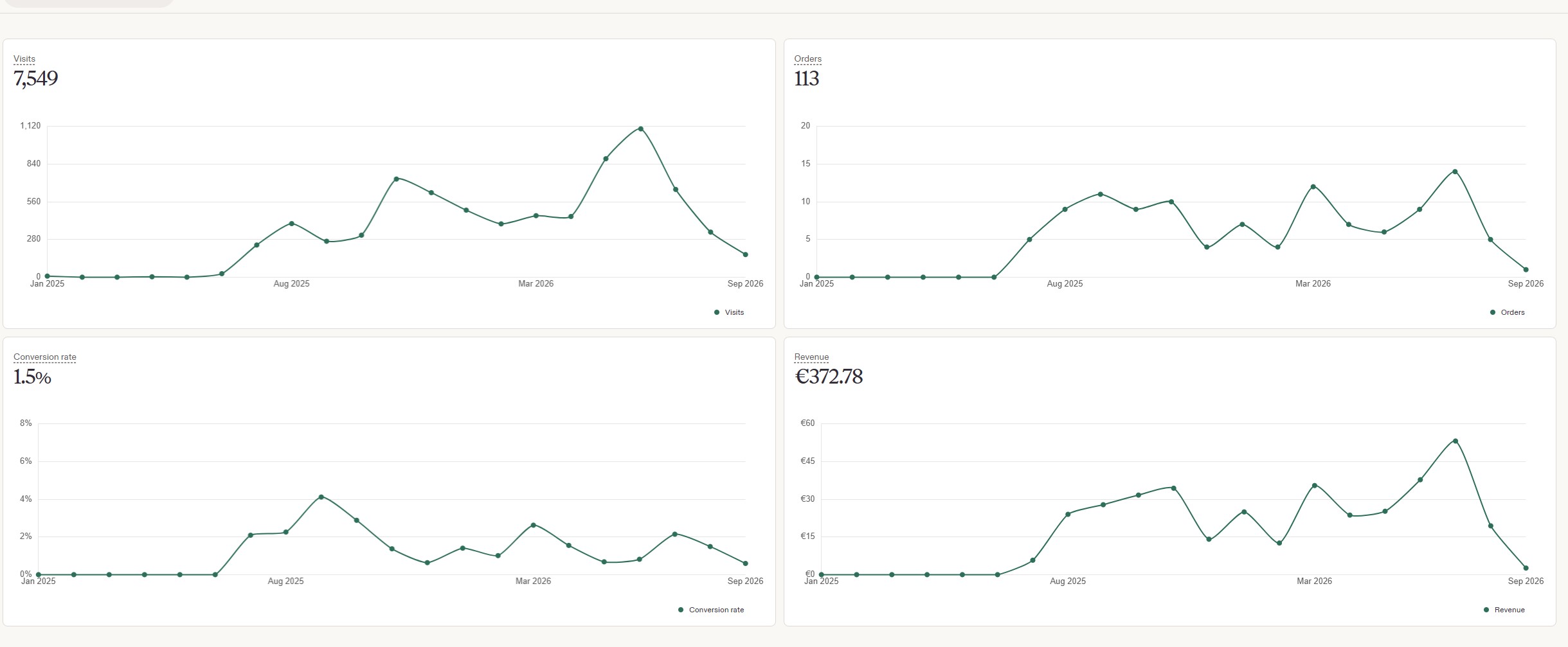
My shop is small. As of 17 September 2026 it has made EUR 372.78 from 113 orders since January 2025, and the last few months went down. Here is the stats screenshot.
Tags are one lever of several. If you haven’t picked a product, what to sell on Etsy compares four paths with real margins. For titles, descriptions and how Etsy ranks a listing, read Etsy SEO. A product line built around Etsy search from day one is in SVG bundles and clipart on Etsy.